
What the Latest Research Tells Us About ERP (and How to Deliver It Effectively)
Introduction
Exposure and Response Prevention (ERP) is widely regarded as the gold standard for treating Obsessive-Compulsive Disorder (OCD) and various severe anxiety presentations. Yet, for many clinicians and clients alike, the very mention of “exposure” can trigger a wave of apprehension. It sounds inherently grueling: deliberately moving toward the thoughts, images, and situations that terrify us most, while simultaneously abandoning the coping strategies (compulsions) that keep us feeling safe.
In theory, ERP is beautifully simple. In practice, it requires an immense amount of clinical precision, collaborative boundary-setting, and therapeutic courage.
Fortunately, research in the past decade has fundamentally reshaped our understanding of why and how ERP works. We are moving away from older, rigid models of “habituation” and toward a more dynamic, flexible approach rooted in inhibitory learning.
Whether you are looking to sharpen your existing exposure protocols or integrate these techniques into a broader CBT framework, here is what the latest evidence tells us about maximizing the clinical impact of ERP.
1. Shift from Habituation to Inhibitory Learning
For decades, therapists taught that exposure works via habituation—the idea that if a client stays in a feared situation long enough, their anxiety will naturally peak and then subside like a wave. Success was measured by how much the subjective units of distress (SUDs) dropped during the session.
However, recent neurobiological and clinical research—pioneered by Michelle Craske and colleagues—has turned this model on its head. We now know that anxiety reduction during a session does not predict long-term recovery. Instead, ERP works through inhibitory learning.
The goal of exposure isn’t necessarily to feel calm; it is to learn that the feared catastrophe didn’t happen, or that even if discomfort persists, it is entirely tolerable. We aren’t erasing the old “fear memory”; we are building a brand-new, more powerful “safety memory” that inhibits the old one.
The Practical Shift: Don’t ask your client “Has your anxiety gone down yet?” Instead, ask: “What did you learn about your ability to handle that thought?” or “Did your predicted disaster actually occur?”
2. Design “Expectancy Violations” Rather Than Rigid Hierarchies
In traditional ERP, we carefully construct a linear fear hierarchy from 1 to 100 and strictly work our way up, ensuring the client habituates to a 40 before moving to a 50.
Inhibitory learning models suggest a more creative, unpredictable approach. The most potent exposures are those designed as expectancy violations.
Before starting an exposure, ask the client to make a highly specific, testable prediction:
- “If I touch this doorknob and don’t wash my hands, what exactly will happen?” * “If I sit with the intrusive thought that I might harm someone, what is the exact timeline of the catastrophe?”
By designing exposures that directly challenge and violate these specific cognitive expectations, we maximize the rate of new learning. Mixing up the contexts, changing the order of the hierarchy, and varying the environments actually creates more robust, relapse-resistant safety memories.
3. Track the “Safety Behaviors” You Cannot See
Response Prevention is the “RP” in ERP, and it is frequently the hardest part of the protocol to enforce. While physical compulsions (like handwashing or checking locks) are easy to spot, cognitive compulsions are highly elusive.
Clients frequently engage in subtle, internal safety behaviors during an exposure to neutralize their distress. These include:
- Mental reassurance: Mutters of “I’m a good person, I wouldn’t do that.”
- Distraction: Mentally reciting lyrics or counting backward.
- Hypervigilance: Continually checking their internal emotional state to see if they feel “truly triggered.”
If a client uses these safety behaviors, the inhibitory learning process is blocked; the brain credits the safety behavior—not the exposure—for their survival. As clinicians, we must explicitly collaborate with clients to identify, track, and drop these hidden cognitive strategies.
4. Lean into Inhibitory Tolerancing (ACT Integration)
What happens when an exposure doesn’t result in a neat cognitive resolution? For instance, when treating existential OCD or certain forms of moral scrupulosity, we cannot definitively prove to a client that their feared outcome is impossible.
This is where integrating Acceptance and Commitment Therapy (ACT) principles becomes invaluable. Instead of aiming for cognitive certainty, ERP becomes about willingness and psychological flexibility.
We help the client lean into the phrase: “I am willing to experience this uncertainty/anxiety in order to live a life aligned with my values.” Success is redefined. It is no longer about achieving a state of zero anxiety; it is about achieving a state of maximum behavioral freedom despite the presence of an intrusive thought.
Moving From Theory to Practice
Delivering ERP effectively requires a careful blend of robust evidence-based theory and compassionate, real-world execution. If you want to dive deeper into the concrete strategies, clinical nuances, and practical workflows for managing complex anxiety presentations, join our upcoming professional development session.
We are running an interactive, high-impact workshop designed specifically for therapists looking to elevate their practical application of these techniques.
👉 Secure your place and view the full agenda here: Practical CBT Professional Development Workshop
Like all of our training, this session will bypass dense academic jargon and focus heavily on live case studies, clear evidence-based frameworks, and actionable toolkits you can bring directly into your therapy room on Monday morning.
About the Author: Prof Patrick McGhee is a fully qualified Chartered Psychologist and a BABCP-accredited CBT therapist with over 30 years of experience in psychological research and private clinical practice.
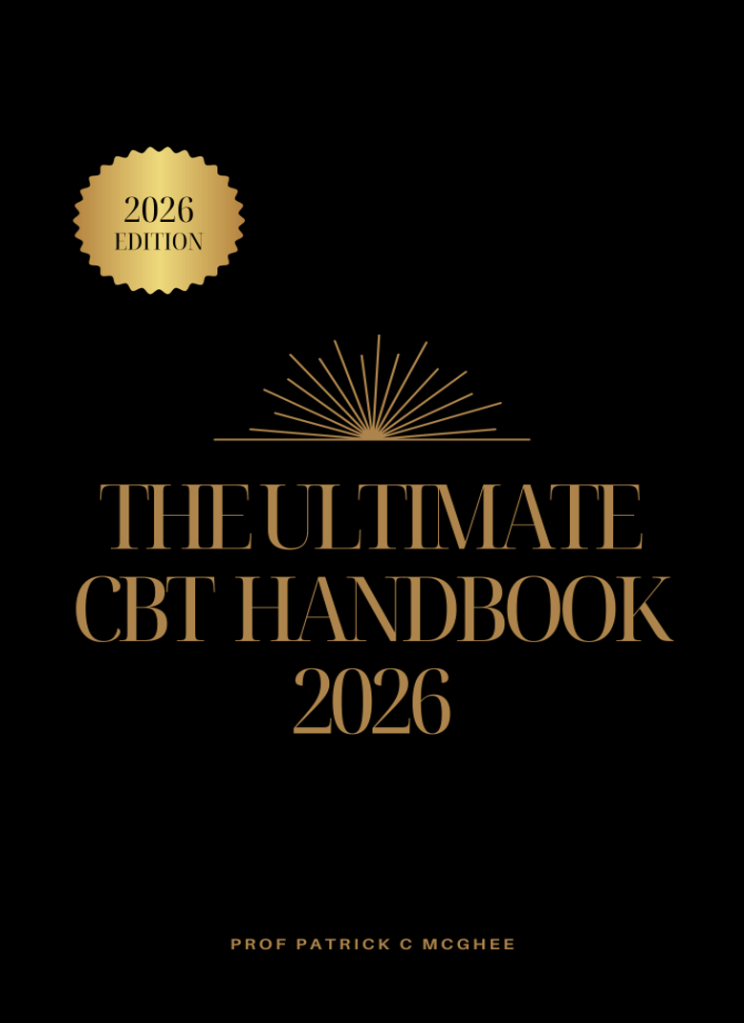
Ultimate CBT Handbook 2026
Get your copy of the latest edition of the indispensible guide to working as a CBT therapist.
What’s inside?
Across 250+ pages, you’ll find:
- A full 2026 planner to map your clinical, personal, and professional year
- Monthly planning and review tools to help you stay intentional rather than reactive
- Core CBT checklists for sessions, risk, homework, neurodiversity, and documentation
- Session agenda templates for first, general, and final sessions
- Mid-treatment review frameworks to recalibrate therapy when things stall
- Supervision toolkits (for supervisees and supervisors)
- Resources for teletherapy, how to handle no-shows, recording sessions, and boundaries
- Neuro-affirmative practice guidance grounded in real clinical work
- Clear, ethical guidance on using AI in CBT (what to use, what to avoid, how to document it)
- Professional development and CPD planning tools, including audit readiness
- Business and fee guidance for UK & Ireland
- Templates for liaising with GPs and Coroners including standard letters pro formas you can use
- Self-care and burnout prevention resources for therapists themselves
- Superb guidance digital developments including the World’s 50 Best Websites for CBT Therapists and the Top Ten free apps for Clients for 2026
- Indispensable Directory Addresses for 20 key organisations in the UK, Ireland and worldwide
Every section is designed to be practical, reusable, and supervision-friendly.
Illustrated in full colour throughout, the text is use friendly with extensive diagrammatic presentation of key concepts, easy to read tables and step-by-step flowcharts.

